


A return after motherhood, Olympic silver, a broader perspective, and the desire to do things her own way. Eva Adamczyková talks about how her view of racing has changed, why sport is still important to her, and how she now connects family, mountains, bike, and life as a professional snowboardcross rider. Openly, with humor and her natural lightness, she reflects on a season that was demanding, different, but ultimately full of joy. And as she says herself, it’s not just a career — it’s also a return to herself. Read the full interview.
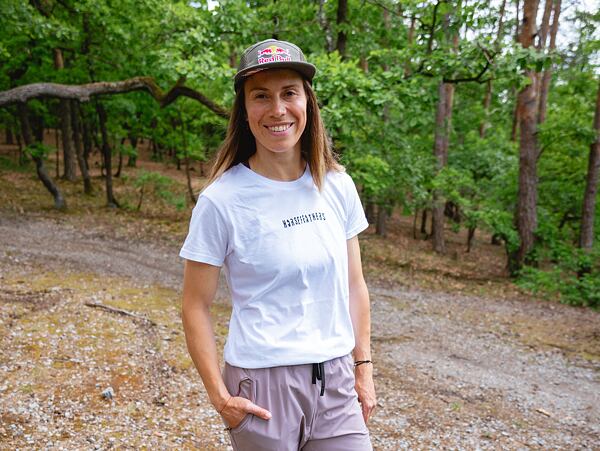
I’d like to follow up on our previous interview. Back then, we ended with you still not knowing what your career and racing would look like after the baby arrived. A year and a half later, you’re racing again and you have an Olympic silver medal. How do you see this whole ride now?
Well, it was pretty intense. Everything actually happened quite quickly, and I have to say the whole process was surprisingly smooth. Compared to what I had been worried about, everything worked pretty well. The little one handled the travelling and everything around it. Of course, it was demanding for everyone around me too, because it took a lot of people and a lot of energy. I had help from two babysitters in Prague, my sister, my husband, his parents, the whole team, and actually all my partners and sponsors as well. Everyone stood by me. It was a lot, but I’m glad it all worked out the way it did. And even better that it happened at the Olympics. That was my only podium of the entire season. I had wished for a podium at the World Cups too, but I told myself that if one was meant to happen, it happened at the right moment. It was truly a huge ride, and I was incredibly happy about it.
Could you describe the difference between standing on the Olympic podium in Sochi when you were twenty, and now, after such a big life change and at a different stage of life? How were the emotions different?
Sochi obviously changed my life when I was twenty. This time, my life didn’t really change anymore. Thank God. The fact that I won silver and my third Olympic medal is amazing, but the difference is probably that I’m much more aware of how much energy and everything else it takes. That it’s not something ordinary at all. I think there was more gratitude this time. After those twelve years, you can see in yourself and in the people around you how much effort it all takes. And you also realize that there aren’t that many people who have won three Olympic medals. At the same time, it was different because after Sochi, my life changed massively. This time, that didn’t really happen. I didn’t become a new sports superstar overnight. It was also different because I had my family there and a lot of close friends, partly because the Olympics were in Europe. In Sochi, I had my team with me, and they’re also my second family, but this time I could experience it with people who don’t normally travel with me to races. I also felt more lightness there. The whole day went by in a pretty relaxed way. A child takes up a lot of your attention, so I didn’t really have much time to be nervous. And that was actually a good thing.
As you mentioned, with this medal you completed your Olympic “collection” of all three medals. Do you feel like it closed a certain chapter for you, or did it give you new energy?
When I broke both my legs before, I really wanted to go to the Olympics in Beijing and I believed I had a shot at a medal, but I couldn’t be there. Now I had this feeling that the medal I thought I would win in 2022 was just put on hold for me. I wasn’t chasing the idea of completing the full set of medals — I only realized that afterwards. But the energy and focus that had been aimed at 2022 somehow came back to me now. I told myself: it didn’t work out back then, I just had to wait a little longer. In that sense, that chapter closed for me a bit. I proved it to myself. But otherwise, not much has really changed. I still love riding and the whole training process. That was a big motivation for coming back after having a child, because I missed it so much. Before, I actually thought I probably wouldn’t come back. That I’d have a family and it wouldn’t be worth it anymore. But during the season when I wasn’t riding and was at home, I realized how much I missed the mountains, racing, preparation, and the whole training process. And that feeling is still there.
Are you possibly already thinking about the next Olympics?
Imagining another Olympics four years from now feels very distant at the moment, and I don’t want to think about it at all yet. The Olympic Games always close a certain four-year cycle, and you naturally start to reflect a bit. Now, of course, it’s no longer just about me. I need to talk it through at home with my family — whether we can manage it and how. In some ways it’s nicer, in some ways more demanding. For now, the 2030 Olympic Games are not within my planning resolution; it’s too far away. This season, we tried one way of making it work as a family — with the little one travelling with me. Now we need to decide at home whether that suits us, or whether we should set it up differently. I’m in a bit of a decision-making period. I had some time off from training after the season, but I’m already looking forward to getting on the bike and starting to move a little again.
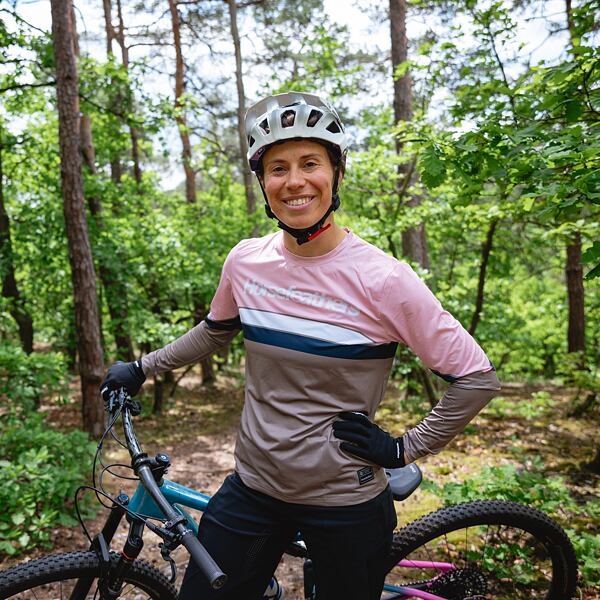
“Returning to riding was important for me. It was actually a return to myself. Sport is such a big part of my life and who I am that I needed it.” — Eva Adamczyková
How do you enjoy everyday life at home and motherhood? Has anything about it surprised you?
Sometimes I enjoy it, and sometimes I don’t. I think all moms have it that way. There are better days and worse days. For me, it’s important to have some space for myself even in everyday life. Some days I don’t manage it, and other days I go horse riding, get on the bike, or do something like that. That’s also why returning to riding was so important for me, and I only realized it afterwards. It was actually a return to myself. Sport is such a big part of my life and who I am that I needed it. It wasn’t about needing to prove myself career-wise again, but about needing to feel a bit like myself again. Being a mom is fantastic, but it’s great to have some balance. I’m not really the type of girl who stays at home only with the child and lets everything else disappear. That’s not me, and I probably wouldn’t be completely happy in that setup. What surprised me the most is probably how inconsistent a child can be. Everything keeps changing. For half an hour, they’re upset and throwing a tantrum, and the next half hour they’re the sweetest little thing and super happy. That variety of moods is mentally demanding. What surprised me most was how hard it is to keep yourself in a good mood.
Has motherhood changed the way you look at sport, your career, or the pressure to get results?
I think I managed to handle the pressure at the Olympics quite well. Of course, it was a lot of pressure, and I felt that something was expected of me, although not as much as in 2018, for example. My performance standard is set pretty high. I talked about it with my former coach, and we came to the conclusion that simply by making it to the Olympics, I had already won for myself. That it was great I managed to come back, and a medal would only be an extra bonus. That helped me a lot. I felt more grateful just to be there at all. That it worked out with the little one, and that I could enjoy it. I think I had more perspective. Even though I feel like I’ve always had quite a healthy perspective on results and racing, motherhood and family strengthened it even more. You tell yourself that it’s amazing to fulfil a dream you didn’t even know you had. And whether you win or not suddenly isn’t absolutely everything. It’s more about the whole process. Of course, when I’m at the start and it’s race day, I want to give it my all and ideally win. But it’s no longer one hundred percent of my attention. It gets spread out a little. Even in training, you have more perspective, because you tell yourself: I don’t need to prove anything to anyone here anymore, not even to myself. And I can enjoy the races more.
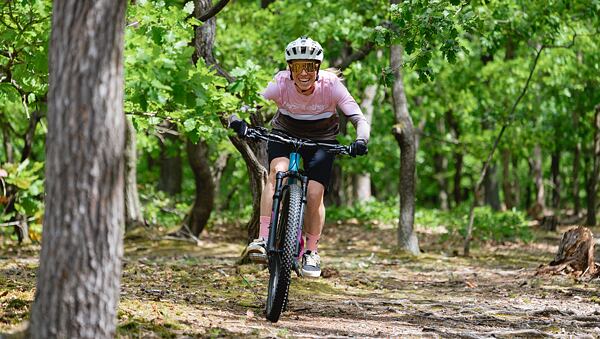
“Just making it to the Olympics was already a win for me. A medal would only be an extra bonus.” — Eva Adamczyková
What role does bike play in your life right now?
Bike is a big form of relaxation for me. At the same time, I feel like I’m not just hanging around, but I can also get some training done through it. On a bike, you can be outside for a longer time, cover more distance, and easily turn it into a trip. I couldn’t run for four hours, for example, but on a bike, that works. For about the last eight years, I’ve been riding trails more, and in some ways it feels like a summer version of snowboardcross for me. A lot of snowboardcross riders spend their summers on bikes and trails. I’m still a beginner at it, though, and I can feel the difference. When a critical situation happens on a snowboard, I know I can handle it. On a bike, I know I definitely can’t, so I’m very careful because I don’t have that much control over the bike yet. But I really enjoy it. You climb up somewhere, then ride down. As a kid, I didn’t know anything like that, and I don’t think I even liked cycling very much. Over the past few years, though, it has become a big form of relaxation for me. I ride easy, chilled trails, but I love it. I also enjoy the whole community around it, and I really like the biker vibe. That’s something I’ve always found great. You can enjoy it whether you’re riding trails with a lift or climbing up somewhere yourself. It’s kind of two in one — fun, and at the same time a good feeling that I’ve “earned” it.
You were recently at an HF shoot together with Tomáš Zejda. How did you enjoy it?
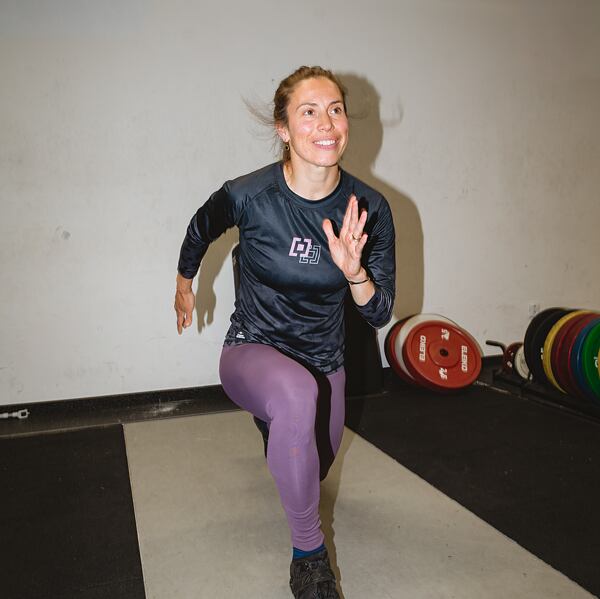
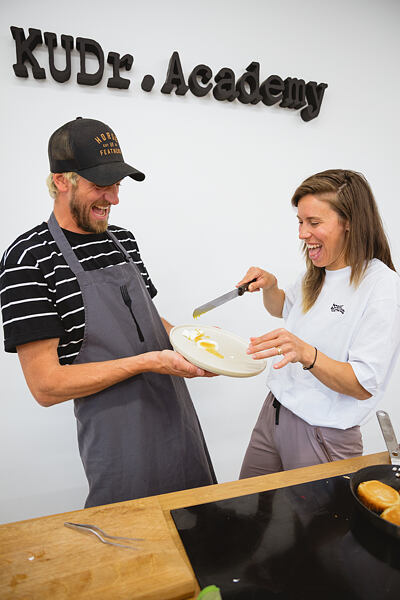
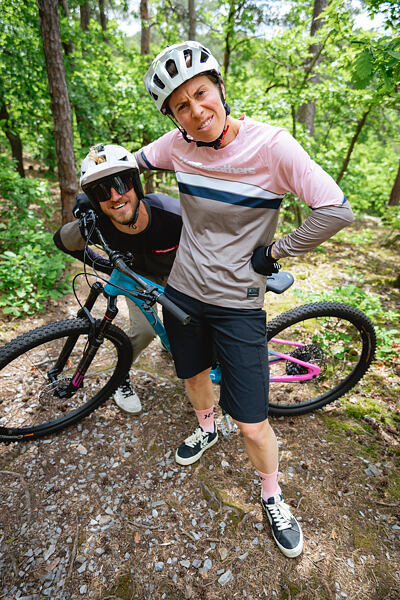
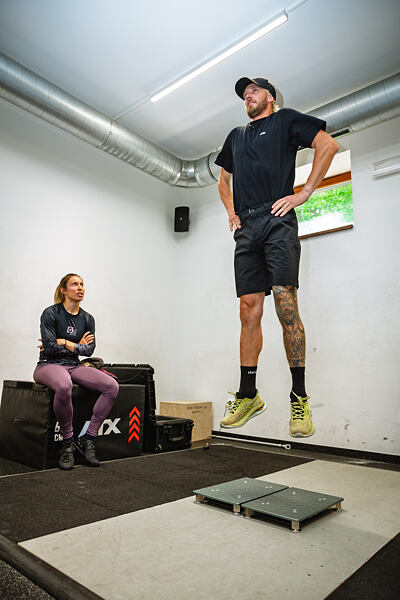
That was fun. With Zejda, it’s a classic — he’s a total showman. It was nice and also interesting because it was quite varied. We started in a café, then went biking, and afterwards Tomáš came with me to the gym. There were plenty of different great moments. And especially the fact that he was making me breakfast in the café — that was funny. The best thing about shoots, and at the same time the worst in a good way, is that we usually see each other after a longer time. We keep telling each other stories, we could just talk nonstop, but we also need to get something done. So we try to chat in between. I always catch up on what he’s been doing, what races he’s run and so on. I think before this shoot, he had just come back from Morocco, where he ran something like 270 kilometres. It’s always a great experience, and I don’t even feel like it’s some big shoot. More like a nicely spent day.
When you see extreme projects, like Zejda’s 270-kilometre run in the Sahara, does it make you want to try something similar?
It feels completely unimaginable to me. At the same time, I know that every now and then, someone can talk me into something like that. I definitely wouldn’t start with something this extreme, but some kind of challenge that you can train for a bit — even as an amateur, knowing it will be mentally and physically demanding — does appeal to me in a way. My first reaction, of course, is that I don’t understand it at all and that I would never do it in my life. But I can imagine that, when it comes to cycling or running, maybe once I get bored, I could prepare for something like that. Longer runs or bike challenges — I’m not completely closing the door on those. Right now it seems crazy to me, but I wouldn’t be surprised if someone talked me into it one day.
Let’s talk about Horsefeathers products. Whether it’s the bike collection or streetwear, do you have any favourites that worked especially well for you, either functionally or style-wise?
Right now, I’m really into all the new bike jerseys. I like wearing them for running and to the gym too. And when it comes to sports pieces, I love the shorts and leggings. I wear them pretty much all the time, and the fit is great. I also wear them a lot together with the sports bras, and they really work for me. From the streetwear side, I like the new grey tie-dye Alana sweatshirt. And also the dark blue Stride hoodie with a small logo in the front, just with a little flower, and a big graphic on the back. I wear that one all the time. And the absolute top are the Conway stretch pants. They’re great. My sister saw them on the website last season and said she thought they would be good. I ordered them in lilac, and they’re absolutely top. I practically lived in them. They’re super comfortable to wear, even at home, but at the same time they look cool and I can easily wear them to the city too. They’re really great.
We recently launched a Rider Edition with Fabi Friedl, a snowboarder from Austria. Would it be interesting for you to have your own small collab with Horsefeathers in the future, maybe a mini edition or your own design?
Yes, I would really love that. I’ve already sent over some of my tips for winter products — what I’d like as a new product, what I feel is missing somewhere, or what I would improve. I’ve done some of my own merch a few times before, mostly simple T-shirts. But having something like that, whether it’s a hoodie, a T-shirt, or a winter jacket with some design, is always cool in my opinion. I know it’s a long run and it can’t be done quickly, but I hope it works out someday. I think Dan Hanka had something similar too, and I really liked that. So yes, definitely.
I heard that you’re a fan of Halldór Helgason. Could you imagine doing some kind of collab or project with him, now that you’re both part of the HF family?
I mean, who isn’t a fan of Halldór, or the Helgasons in general? I remember the time when they first came onto the scene, and it was a total wow effect. It was brutal — something that just wasn’t really happening in snowboarding at that time. I think we were all just watching in awe. I’d love to, I’m just a bit cautious about it, because those guys are absolute beasts and really complete snowboarders. I think they’d have no problem riding a snowboardcross course. But I, on the other hand, have a bit of a problem with the freestyle part, haha. Still, I’d be really curious to see what they could do on a snowboardcross board. What kind of tricks they would throw down on it. If they’re somewhere in Czech republic again next year and there’s some kind of riding event, I’d definitely love to join. Meeting legends like that would be really interesting for me. And if it could be turned into some kind of edit, that would be super cool. From what I’ve heard, they’re pretty radical at afterparties too. I feel like today’s snowboarders don’t party as much as they used to, but they’re still keeping that bar high. I’d enjoy connecting something like a small snowboardcross course with freestyle riders. Even back when I was little and Honza Zajíc was riding, we had this idea for a photo: a crew of snowboardcross riders going through a berm, with a freestyler jumping above them. That must have been fifteen or twenty years ago. Things like that feel cool to me.
To finish, when you look at the next few months, what’s coming up for you in sport, family, or personal life? Do you have any plans?
I’m mainly looking forward to getting out on the bike. We also have a bike trailer, so I’d like to go on some easy rides with the little one. He’s bigger now, and I think he could handle it. I want to enjoy the summer in Czech republic. I’m not planning anything big or specific. I’ll be at Red Bull 400, that uphill running race, and that’s probably about it. But I hope I’ll spend as much time as possible on the bike. Last year, I didn’t really manage that because the little one was still very small, so this year I’d like to get back into it more.


